


Mahasthamaprapta Bodhisattva: Great Strength, Pure Land Wisdom & Thangka Jewelry Guide
Mahasthamaprapta: The Bodhisattva of Great Strength Who Illuminates the Way to the Pure Land
Among the Western Three Sages — the triad of Amitabha Buddha flanked by two bodhisattvas — Avalokiteshvara (Guanyin) is universally beloved. Yet her companion on the other side of Amitabha is no less remarkable. Mahasthamaprapta Bodhisattva is the second attendant, and while he may be less widely known in the West, within the tradition of Pure Land Buddhism he holds a position of extraordinary power and significance — standing as a living bridge between the human world and the realm of liberation.
His name says everything: "Great Strength Attained" — or more evocatively, the one who arrives with a power so vast that his very footstep causes the three thousand worlds to tremble. This guide explores Mahasthamaprapta's origins, his unique iconography, his incomparable Mindfulness of Buddha Samadhi, his role as the guardian for those born in the Year of the Horse, and why his thangka pendant is a powerful talisman for those seeking inner strength, wisdom, and liberation.
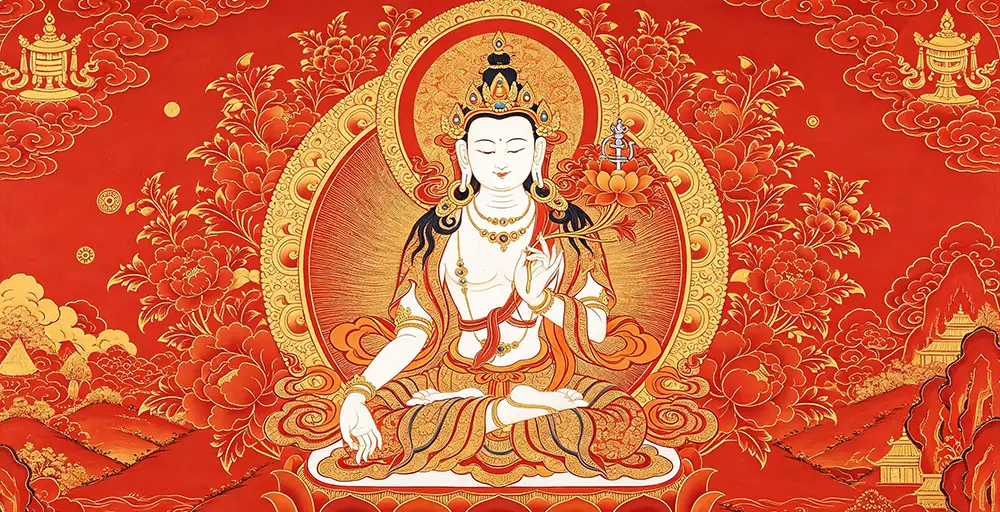
Who Is Mahasthamaprapta Bodhisattva?
Mahasthamaprapta (Sanskrit: महास्थामप्राप्त) stands alongside Amitabha Buddha and Avalokiteshvara in the Western Pure Land (Sukhavati), collectively forming the Western Three Sages. His name, rendered in Sanskrit, translates as "One Who Has Obtained Great Strength" — and in the Infinite Life Sutra, his power is described with breathtaking clarity:
"Mahasthamaprapta, through the radiance of his boundless wisdom, illuminates the world, enabling all beings to be freed from the calamities of war and bloodshed, attaining supreme power."
He is also known as the Bodhisattva of Boundless Light — for his wisdom does not merely shine, it liberates. His light reaches into the three lower realms (hell, hungry ghosts, animals) and lifts beings from suffering, granting them access to the vast, pure expanse of awakened mind.
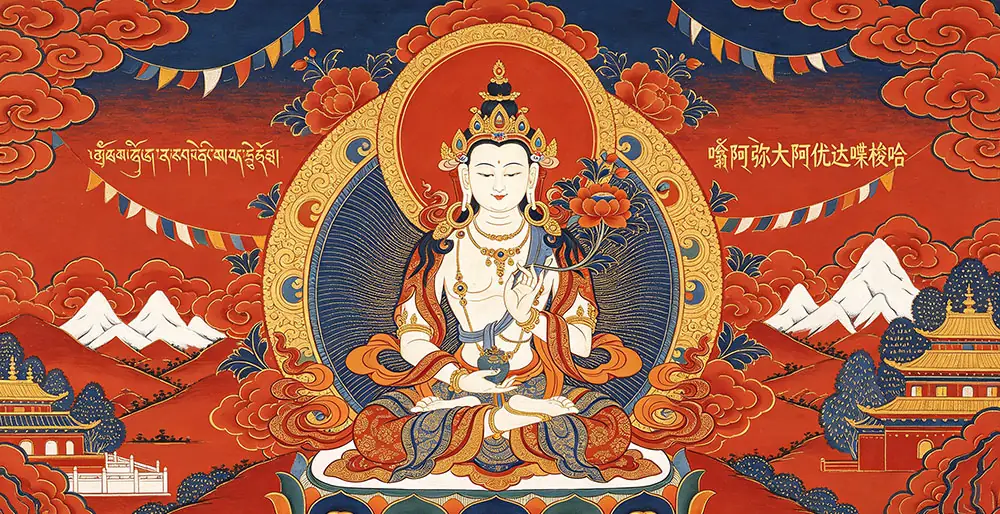
The Legend of His Name: A Vow Spanning Cosmic Time
The origins of Mahasthamaprapta's name are recorded in the Sutra of Compassionate Blossoms. In a primordial age, when Amitabha Buddha was still a Wheel-Turning King, Avalokiteshvara was his first prince and Mahasthamaprapta was his second. When the Treasure Store Buddha prophesied the enlightenment path for Amitabha and Avalokiteshvara, Mahasthamaprapta made his own great vow:
"When I become a Buddha, the propagation of Dharma and the purity of my land shall be equal in every way to that of Avalokiteshvara."
Moved by this vow, Treasure Store Buddha predicted that Mahasthamaprapta would one day become a Buddha named Virtuous Treasure Mountain Tathagata. Because of his vow to bring forth a pure and magnificent world, he was given the name "Mahasthamaprapta" — the one who attains great strength.
The Crown Bottle: A Symbol of Filial Devotion
Mahasthamaprapta's iconography is nearly identical to that of Avalokiteshvara — with one essential, distinctive difference. While Avalokiteshvara wears a crown bearing a Buddha image, Mahasthamaprapta's crown holds a precious bottle.
Behind this bottle is a deeply moving story. During his bodhisattva practice, Mahasthamaprapta lost both parents at a young age. In an act of profound filial devotion, he placed his parents' remains in a bottle atop his head, committing all his spiritual practice and merit to their liberation. Over time, through the power of his practice, the bones within the bottle were transformed — they began to radiate light, and the bottle itself became a sacred treasure. This light was capable of reflecting all the Buddha's teachings and became a symbol of his wisdom, compassion, and the transformative power of sincere devotion.
The Mindfulness of Buddha Samadhi: The Surangama Sutra's Greatest Teaching
Among all of Mahasthamaprapta's contributions to Buddhist practice, none is more celebrated than his method of Mindfulness of Buddha, detailed in the Surangama Sutra.
The sutra explores twenty-five methods of "perfect penetration" — paths to awakening through the sense faculties. Two are regarded as supreme: Avalokiteshvara's Ear Gate method (hearing sounds) and Mahasthamaprapta's Mindfulness of Buddha practice. His teaching, preserved in just 289 Chinese characters, contains one of the most profound images in all of Buddhist literature:
"Just as a child who always remembers their mother cannot forget her even when they are apart — if the mother also remembers the child, both will never be far from each other across many lifetimes. In the same way, if beings remember the Buddha with sincere and continuous mindfulness, the Buddha will certainly appear before them — in this life or the next, they will never be separated."
The practice is simple in form but profound in depth: gather the six sense faculties, maintain pure and unbroken mindfulness of the Buddha. Over time, this singular practice leads to samadhi — the perfect, unshakable union of the practitioner's mind with the Buddha's wisdom.
Mahasthamaprapta as Guardian of the Horse Zodiac
In the Chinese Buddhist system of Zodiac Guardian Buddhas, those born in the Year of the Horse are under Mahasthamaprapta's lifelong protection. Horse personalities in Chinese astrology are known for their dynamism, independence, strength, and tireless pursuit of freedom — qualities that resonate deeply with a bodhisattva whose very name means "Great Strength Attained." For those born under this sign, wearing Mahasthamaprapta's image is believed to:
- Strengthen inner resolve and the power to persevere through life's challenges
- Invoke Mahasthamaprapta's boundless light to illuminate the path forward
- Provide protection from harmful forces and dispel negative karma
- Support spiritual practice and the cultivation of a focused, clear mind
- Invite the blessings of the Western Pure Land into daily life
Wearing Mahasthamaprapta: The Thangka Pendant as a Lamp in the Dark
A hand-painted Mahasthamaprapta Thangka pendant, housed in a traditional Gawu Box, is a wearable lamp — a small, steady source of the bodhisattva's illuminating wisdom carried close to the heart throughout the day. For those who practice mindfulness of the Buddha, the pendant becomes a tangible focal point, a sacred object that anchors the wandering mind and calls it back — gently, persistently — to the light.
Who Should Wear a Mahasthamaprapta Pendant?
- Those Born in the Year of the Horse: Wearing their life's guardian deity for protection, strength, and ongoing blessings.
- Pure Land Practitioners: Strengthening their practice of mindfulness of the Buddha with a sacred visual anchor.
- Those Seeking Inner Strength: Drawing on Mahasthamaprapta's vast power to face challenges with resilience and clarity.
- Those Honoring Parents or Ancestors: Connecting with his spirit of deep filial devotion and the transformative power of love.
- Anyone Feeling Lost or Overwhelmed: Mahasthamaprapta's light reaches even the darkest places — he is the bodhisattva for those who feel forgotten.
"Remember the Buddha as a child remembers a beloved mother. Let not a single thought go unremembered. This is the direct path — simple, complete, and inexhaustible." — Mahasthamaprapta's teaching from the Surangama Sutra