


Amitabha Buddha: The Buddha of Infinite Light — Meaning, Pure Land & Thangka Jewelry Guide
Amitabha Buddha: The Infinite Light That Never Stops Shining on You
Of all the Buddhas venerated across the vast landscape of Mahayana Buddhism, one name has been whispered, chanted, and held in the hearts of more practitioners than perhaps any other: Amitabha — the Buddha of Infinite Light. In China, Japan, Korea, Vietnam, and wherever Pure Land Buddhism has taken root, this single name carries the weight of centuries of devotion, the hope of countless souls, and the promise of a light that does not fade, a compassion that does not run out, and a welcome that is never withdrawn.
Amitabha is not simply a deity to be worshipped from a distance. He is — in the Pure Land tradition — a living, active presence who seeks you out, whose compassion flows toward you like a current, and who has made specific, binding vows to ensure that no one who sincerely calls upon him will be left behind. This guide explores Amitabha's origins, his 48 Great Vows, the nature of the Western Pure Land, the ten extraordinary benefits of his practice, his role as guardian for the Dog and Pig zodiac signs, and why his thangka pendant is one of the most beloved spiritual objects in the Buddhist world.
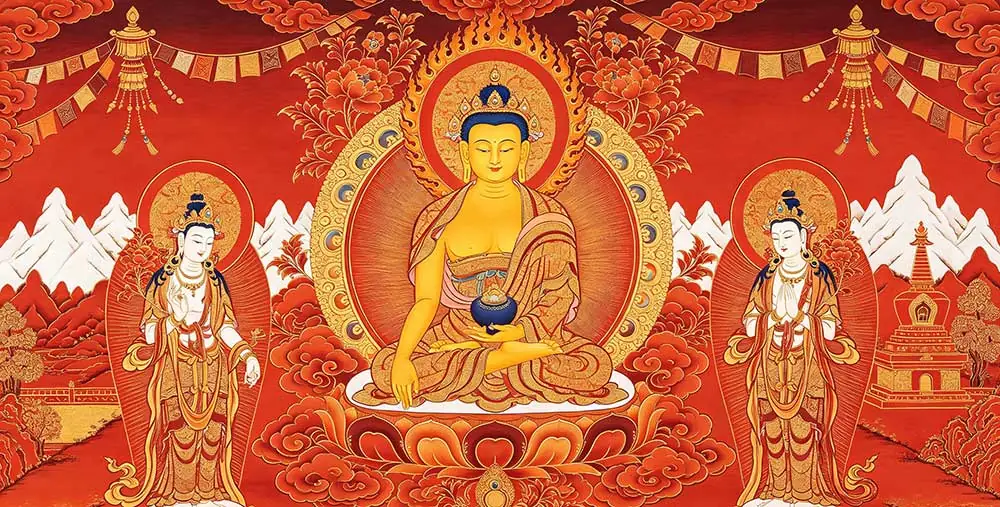
Who Is Amitabha Buddha?
Amitabha (Sanskrit: अमिताभ) is the Buddha of the Western Pure Land , known by two equally profound titles: Amitabha ( "Infinite Light") and Amitayus ( "Infinite Life"). These two names capture his essential nature — an inexhaustible luminosity paired with an unending longevity, a being in whom light and life are synonymous and without limit.
In the Western Pure Land, Amitabha presides alongside two bodhisattvas: Avalokiteshvara (Guanyin) on his left, representing compassion, and Mahasthamaprapta on his right, representing wisdom and strength — together forming the Western Three Sages. This triad works as one to guide practitioners toward liberation — compassion reaching out, wisdom illuminating the way, and Amitabha's infinite light holding everything in its gentle, inexhaustible embrace.
The Story of the Monk Dharmakara: 48 Vows That Changed Everything
The origins of Amitabha and his Pure Land are told in the Infinite Life Sutra . In an ancient age, a great king heard the teachings of the Buddha Lokesvararaja and was so moved that he renounced his throne to become a monk named Dharmakara. Over the course of five kalpas (vast cosmic ages), Dharmakara meditated and contemplated, studying countless Buddha realms, before making 48 Great Vows before his teacher.
The most transformative of these vows was the 18th Vow: "If, when I attain Buddhahood, sentient beings in the ten directions who sincerely believe in me, desire to be reborn in my land, and say my name even just ten times, are not reborn there — may I not attain perfect enlightenment."
Dharmakara kept every one of his vows. He became Amitabha Buddha. The Pure Land was established. And his vow — that no sincere devotee who calls his name will be turned away — remains active to this day.
The Western Pure Land: A World Without Suffering
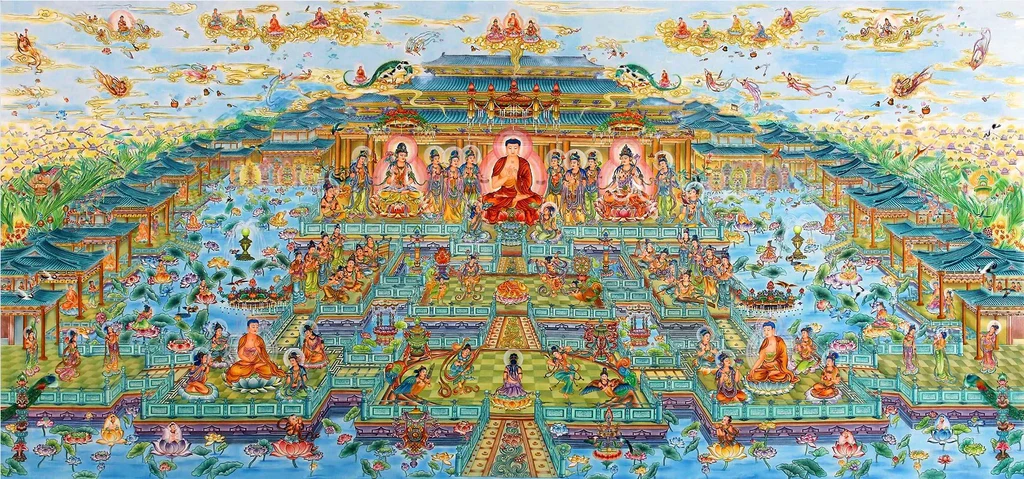
The Western Pure Land (Sukhavati — "Land of Ultimate Bliss") is described in the sutras with extraordinary beauty:
- Golden ground that reflects the light of countless jewels
- Pools of eight-merit water made of precious gems, fringed with blooming lotus flowers
- Celestial music drifting through perfumed air
- Rare, luminous birds singing the Dharma
- No suffering, no conflict, no deception — only eternal spring and serene joy
Yet the Pure Land is more than a beautiful paradise. In Pure Land Buddhism, it is understood as the optimal environment for spiritual practice — a realm where the conditions for awakening are perfect, where every encounter deepens wisdom, and where one can practice without the distractions, obstacles, and suffering that fill ordinary existence. To reach the Pure Land is not the end of the journey — it is the beginning of its final, unobstructed stage.
The Ten Benefits of Chanting Amitabha's Name
The practice of reciting Amitabha's name — Nāmo Amitābhāya — is one of the most widespread and accessible spiritual practices in all of Buddhism. The sutras enumerate ten profound benefits for those who maintain this practice sincerely:
- Protection by powerful guardian deities at all times
- The blessings of 25 great bodhisattvas, including Avalokiteshvara
- Amitabha's light shining upon you continuously, day and night
- Protection from evil spirits, harmful creatures, and destructive forces
- Avoidance of disasters including fire, flood, and untimely death
- Gradual cleansing of past misdeeds and negative karma
- Auspicious dreams and, for some, visions of Amitabha's radiant form
- Greater joy, improved vitality, and a brightening of the complexion
- Being respected and honored by others, as one who carries the Buddha's blessing
- At the time of death, Amitabha and his retinue appearing to guide the devotee to the Pure Land
Amitabha as Guardian of the Dog and Pig Zodiac
In the Chinese Buddhist system of Zodiac Guardian Buddhas , those born in the Year of the Dog and the Year of the Pig are under Amitabha's lifelong guardianship.
Both Dog and Pig personalities in Chinese astrology share qualities of loyalty, sincerity, warmth, and an open-hearted generosity — qualities that resonate deeply with Amitabha's nature of unconditional acceptance and infinite compassion. For those born under these signs, wearing Amitabha's image is believed to:
- Activate the direct, personal protection of Amitabha's 48 Vows
- Invite peace, serenity, and emotional harmony into daily life
- Provide protection at all stages of life, including the critical moment of death
- Gradually purify accumulated negative karma and attract auspicious circumstances
- Strengthen faith, sincerity, and the capacity for wholehearted devotion
Wearing Amitabha: The Thangka Pendant as a Lifeline
A hand-painted Amitabha Thangka pendant, housed in a traditional Gawu Box, is unlike any other piece of jewelry. It is a lifeline — a tangible expression of the connection between the wearer and a being who has made binding vows to never abandon anyone who turns toward him. To wear Amitabha's image is to walk through the day with the knowledge that infinite light surrounds you, that a compassion without limit flows in your direction, and that no matter what happens, you are not alone.
In the simplest and most profound sense, an Amitabha pendant is a reminder of the most important teaching in Pure Land Buddhism: You are already received. You have only to turn toward the light.
Who Should Wear an Amitabha Pendant?
- Those Born in the Year of the Dog or Pig: Wearing their life's guardian deity for ongoing protection and blessings.
- Pure Land Practitioners: Keeping Amitabha close as a visual anchor for their daily chanting practice.
- Those Facing Illness, Loss, or End of Life: Amitabha's vow is especially powerful at life's most vulnerable moments.
- Those Seeking Peace and Emotional Healing: Drawing on his infinite compassion for comfort, serenity, and the release of grief.
- Anyone Who Feels Unworthy of Blessings: Amitabha's 18th Vow is explicit: he turns no one away. Not one.
"Even just ten sincere recitations. Even at the very last moment. Even if your heart has been wandering for a lifetime. Amitabha's vow is unconditional. His light reaches you wherever you are."